
Blog
Veeva Alternatives? Welcome to the Era of Pharma Hybrid Tech Stacks
Explore hybrid pharma technology stacks as a way to add specialized commercial capabilities alongside existing enterprise systems.
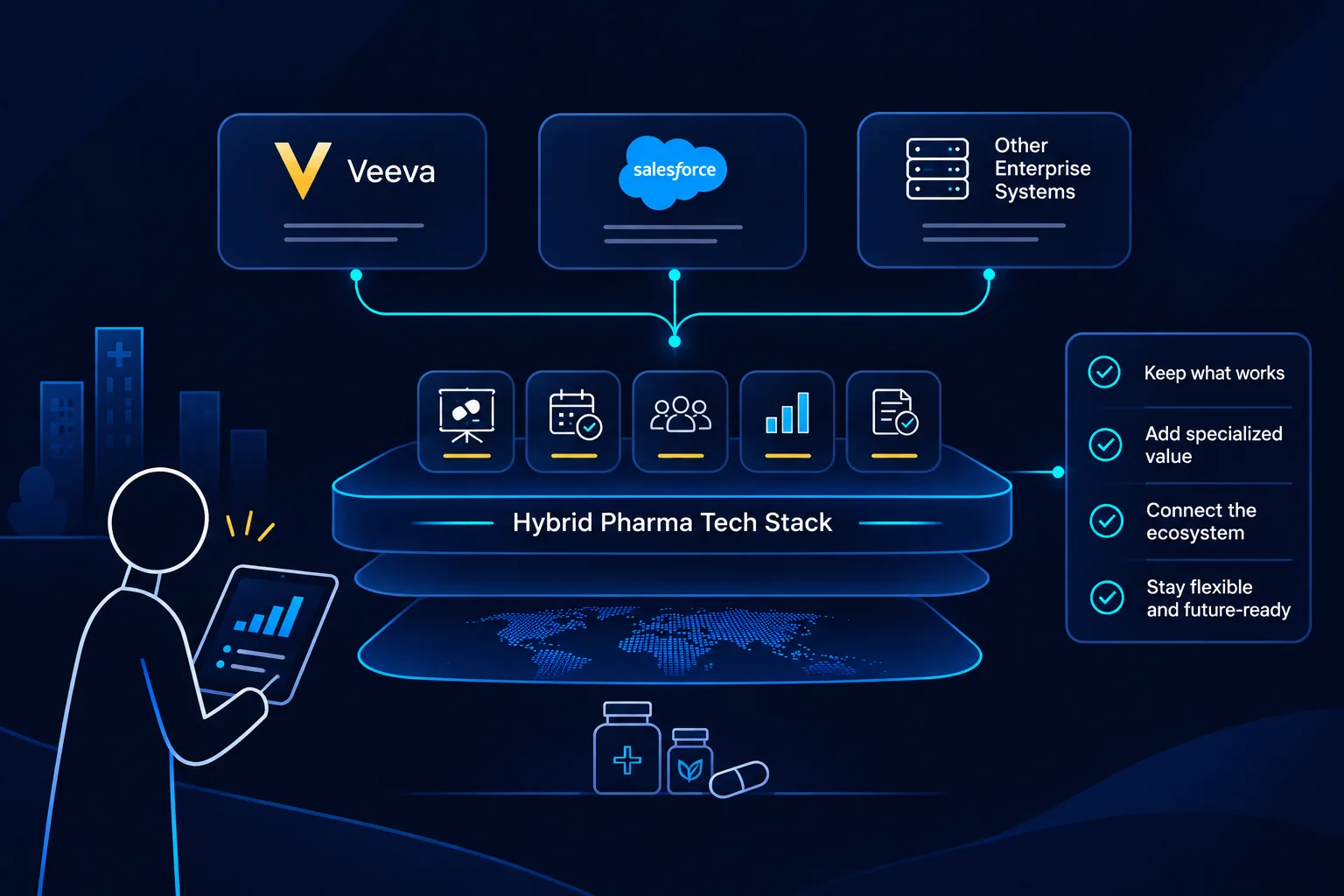
If we could ask Google what technology-related questions pharmaceutical companies have been searching for most lately, we'd bet "Veeva alternatives" would be somewhere near the top of the list.
And we wouldn't be particularly surprised.
With Veeva moving away from the Salesforce ecosystem and transitioning customers to Vault CRMOpens in a new window, pharmaceutical companies are facing a technology decision they didn't necessarily initiate.
For some, it's a straightforward transition. For others, it means revisiting years of integrations, customizations, and investments, with potentially significant implications for cost, complexity, and time.
Naturally, this raises a question: Should we migrate with Veeva, or consider alternatives?
If you're looking for a head-to-head comparison, we've already covered that in our 2026 Pharmaceutical CRM Comparison Guide, comparing REVOsuite, Veeva, Salesforce Life Sciences Cloud, and IQVIA OCE.
If you're specifically evaluating the challenges of migrating from your existing Veeva environment, you may also find our Veeva CRM Migration Guide useful.
But this article explores a different direction.
What if the best alternative to Veeva isn't another CRM, but an entirely different approach to building your pharmaceutical commercial technology ecosystem?
From our 15 years of experience working with pharmaceutical companies, and considering recent developments in both technology and pharma, we believe an important shift is emerging.
Welcome to the era of hybrid pharmaceutical technology stacks.
An approach where companies retain the enterprise systems that already work, introduce specialized solutions where they deliver additional value, and connect everything into a coherent, governed ecosystem.
It's not about abandoning enterprise platforms or accumulating dozens of software providers.
It's about having the freedom to choose.
1. The Single-Vendor Dilemma: When Technology Boundaries Become Business Constraints
Historically, pharmaceutical companies have had legitimate reasons to favor consolidated technology ecosystems.
One major provider can simplify procurement, integration, data management, compliance, and day-to-day operations.
But consolidation comes with a trade-off: the more your business depends on one technology ecosystem, the more consequential changes to that ecosystem become.
Veeva's transition from Salesforce to Vault CRMOpens in a new window provides a timely illustration.
While the move may bring technological benefits, existing customers must evaluate the effort involved in migrating integrations, customizations, workflows, and supporting processes.
A strategic decision made by a technology vendor can become a significant project for its customers.
And that brings us to another dilemma we've encountered repeatedly.
The ERP Dilemma: A Lesson From 15 Years in Pharma
For the past 15 years, pharmaceutical customers have frequently asked us to introduce ERP-like functionality into their CRM.
Vacation requests, expense approvals, administrative processes, and other internal workflows.
Initially, our reaction was:
Isn't that what your ERP is supposed to do?
Their answer was usually practical:
"Why should I pay for additional ERP licenses for hundreds of medical representatives who only need to submit a vacation request?"
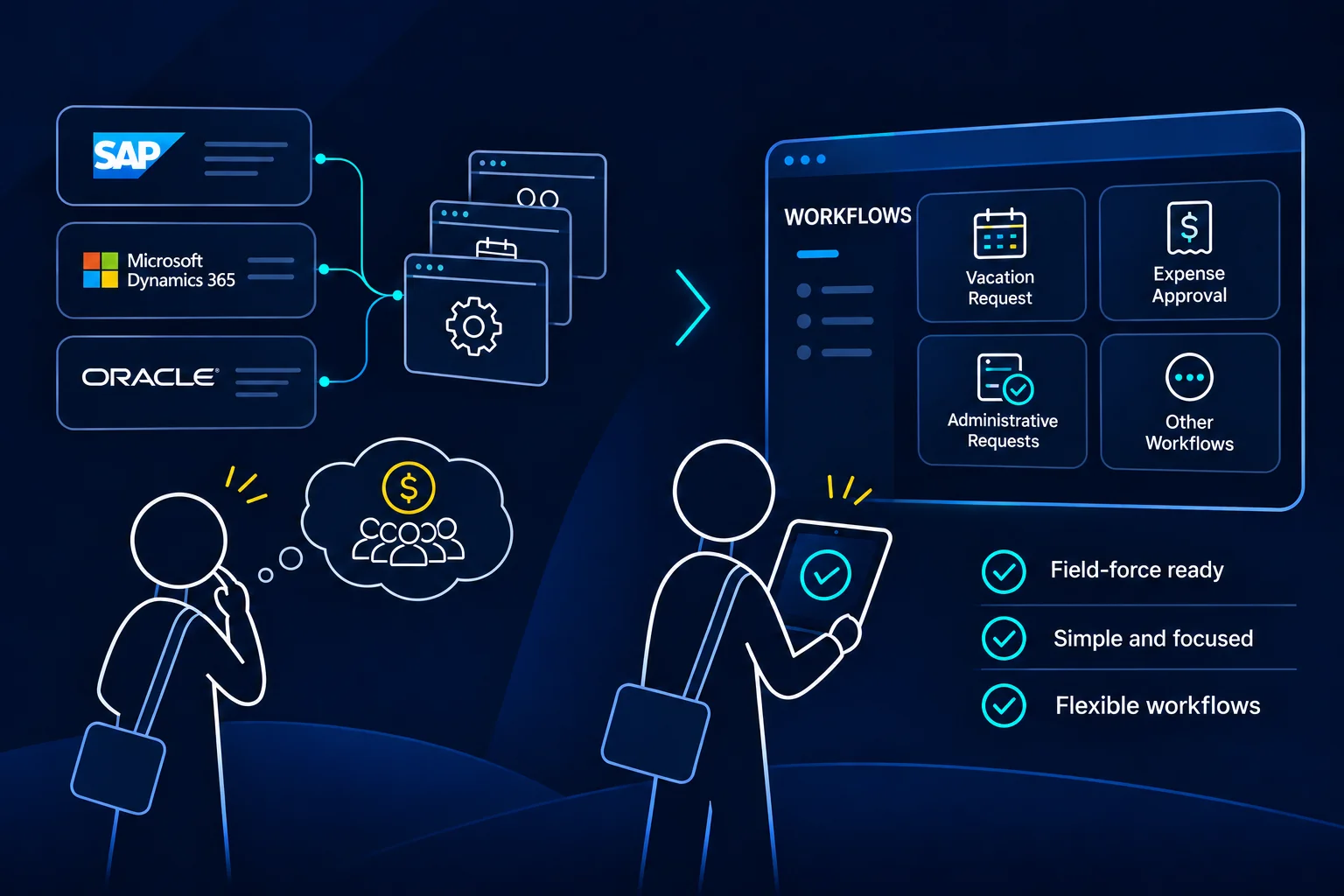
And they had a point.
Enterprise platforms such as SAP and Microsoft Dynamics 365 offer extensive business capabilities. Many companies also have investments in Microsoft 365 and its workflow and collaboration toolsOpens in a new window.
But field-force representatives shouldn't necessarily need to navigate multiple enterprise applications to complete relatively simple tasks.
Over time, we realized something important.
Our customers weren't asking the wrong question. We were.
Technology exists to solve business problems, not to force businesses to operate within software boundaries established years ago.
Today, APIs, low-code tools, configurable workflows, and AI-assisted automation offer more possibilities for connecting systems without rebuilding them.
Instead of duplicating ERP functionality inside CRM, companies can introduce a commercial workflow layer that provides a straightforward experience for field teams while synchronizing the necessary information with their enterprise systems.
The ERP retains its authoritative records. The CRM manages customer relationships. Commercial workflows connect the processes between them.
Subject, of course, to the applicable licensing and integration requirements.
The key distinction: An integrated technology ecosystem doesn't necessarily have to be a single-vendor ecosystem.
2. Why Hybrid Technology Makes More Sense Today
The tension between business requirements and enterprise software boundaries isn't new.
What's changed is the technology available to address it—and the commercial pressures making flexibility increasingly valuable.
We see four developments worth considering.
AI Evolution: Don't Let Your Architecture Limit Your Ambitions
AI capabilities are evolving rapidly, challenging traditional enterprise software development cycles.
Pharmaceutical companies are exploring AI for field-force coaching, customer segmentation, commercial analytics, content operations, and workflow automation.
But should adopting these capabilities depend entirely on when a company's primary enterprise vendor makes them available?
Not necessarily.
A hybrid architecture can allow organizations to evaluate specialized AI solutions while retaining their existing enterprise systems.
More importantly, AI readiness is increasingly an architectural consideration, not simply a software feature.
AI applications need access to reliable data and well-defined processes, often spanning CRM, ERP, detailing, and other commercial systems.
The more effectively those systems can exchange information under appropriate controls, the more options companies have for introducing useful AI capabilities.
The Rise of Generics: Commercial Speed Matters
Generic pharmaceutical manufacturers often operate under considerable pricing pressure, making operational efficiency and commercial agility especially important.
According to the Association for Accessible Medicines' 2026 reportOpens in a new window, generic medicines accounted for approximately 89% of US prescriptions filled in 2025 while representing only 11.6% of prescription-drug spending.
Although market economics differ across countries, the underlying pressure to operate efficiently is clear.
For commercial teams, this can mean launching products quickly, updating promotional materials frequently, and adapting field-force activities to changing market conditions.
When every operational improvement requires an extensive enterprise customization project, technology risks becoming a bottleneck.
A selective hybrid approach can help companies introduce new commercial capabilities without rebuilding their existing infrastructure.
The objective isn't simply cheaper software. It's faster execution and better use of commercial resources.
Specialized Technology: Even Industry Giants Are Looking Beyond Their Own Ecosystems
Perhaps one of the most interesting recent examples of technology specialization comes from the pharmaceutical industry's own technology leaders.
In October 2026, IQVIA announced an expanded partnership with VeevaOpens in a new window, selecting several Veeva clinical operations applications—including CTMS, eTMF, Study Startup, and Site Connect—as enterprise standards for its clinical development studies.
Yes, IQVIA and Veeva—two companies that compete in parts of the pharmaceutical technology market.
Although this partnership concerns clinical operations rather than commercial CRM, it illustrates an important principle: technology choices don't always have to follow competitive or vendor boundaries.
Data Residency: Different Markets, Different Requirements
For multinational pharmaceutical companies, technology decisions must also account for regional hosting preferences, data protection regulations, security policies, and infrastructure requirements.
A global CRM deployment may not be the ideal hosting model for every complementary application.
Hybrid architectures can provide more flexibility to deploy specialized solutions according to local requirements while maintaining appropriate integration with enterprise systems.
Of course, local hosting doesn't automatically guarantee compliance, and hybrid deployments still require careful management of data access, transfersOpens in a new window, and security.
The advantage is having more architectural options—not avoiding regulatory obligations.
3. Hybrid in Practice: Two Business Problems, Two Different Solutions
What makes the IQVIA–Veeva partnership interesting isn't simply that two technology companies are working together.
It's the principle behind the decision: selecting technology based on the value it delivers for a particular business function.
We've encountered the same reasoning among pharmaceutical commercial teams.
Sometimes, companies need capabilities their existing CRM doesn't adequately provide.
Other times, their CRM already offers the functionality, but delivering it through a specialized solution makes more sense in terms of cost, speed, or flexibility.
Different business problems can call for different technology decisions.
- If the issue isCore CRM fit
The CRM itself no longer meets essential business needs.
Options to evaluateAdapt the CRM or evaluate a replacement - If the issue isA missing capability
The existing CRM does not adequately provide a needed capability.
Options to evaluateExplore an extension or specialized solution - If the issue isA difficult workflow
The capability exists, but delivering your specific process is difficult.
Options to evaluateCompare CRM delivery with a specialized solution
We've seen both situations firsthand.
Here are two examples.
Case 1: Modernizing Digital Detailing Without Replacing CRM
Several pharmaceutical companies operating their own in-house CRMs faced a familiar challenge.
Printed promotional materials were expensive to produce and distribute.
PDFs offered a cheaper alternative but provided little visibility into promotional interactions and lacked the structured workflows needed to improve detailing adoption and field-force performance.
Traditional HTML5-based closed-loop marketing solutions were another option, but could introduce specialized production requirements, expensive agencies, and longer development cycles.
Rather than replacing their CRM, these companies adopted REVO Rx-Booster.
Rx-Booster synchronized representatives' customer lists through an integration workflow and could report detailing activity back to the existing CRM.
The customers' initial concern was integration complexity. Would adding another platform require extensive development? Would representatives have to duplicate their reporting?
In practice, the relatively straightforward integration and familiar detailing experience helped address those concerns.
Deployments could be completed in approximately one month, depending on the environment.
The companies reported reduced promotional content production and distribution costs, substantial improvements in detailing compliance, and more granular promotional insights that supported training and coaching.
The lesson? You don't necessarily need to replace your CRM to modernize a critical commercial function.
Case 2: A Multinational Choosing REVO Approvals Alongside Veeva
A multinational pharmaceutical company already using Veeva needed to digitize a complex regional event-management process involving field-force representatives, medical teams, and marketing.
Veeva offered capabilities that could support the process.
However, the company's evaluation indicated that delivering its particular requirements within the existing platform would involve additional customization, time, and cost.
The regional organization therefore evaluated a specialized alternative and selected REVO Approvals.
The decision was driven by implementation speed, cost, flexibility, and regional relevance.
REVO Approvals' no-code configuration allowed the required workflows and approval responsibilities to be established without extensive custom development.
The solution also retrieved representatives' customer lists from the existing CRM, allowing healthcare professionals to be associated with event requests.
Veeva remained in place, while procurement was handled through the multinational headquarters.
Just two weeks after signing, the solution was launched and teams could begin submitting event requests.
This is a particularly interesting example because Veeva wasn't incapable of supporting the required processes.
The company simply found that a specialized solution offered a more practical implementation path for its regional requirements.
Hybrid technology isn't only about adding capabilities your existing vendor lacks. Sometimes, it's about delivering existing capabilities more efficiently.
4. Hybrid Without Chaos: Getting the Architecture Right
At this point, an obvious concern emerges.
If pharmaceutical companies start adopting specialized applications, won't they eventually replace one complicated ecosystem with a collection of disconnected systems?
That's a legitimate concern.
And it's why hybrid should never mean fragmented.
We believe companies should begin with a manageable architectural framework:
ERP → CRM → Commercial Workflows
ERP
Enterprise operations & records
- Finance & accounting
- Procurement
- Inventory & orders
- Employee records
CRM
Customer relationships & field activity
- Customer list governance
- Manual visit reporting
- Visit planning
- Sample drop reporting
Commercial workflows
Specialized processes & execution
- Detailing
- MLR approvals
- Event management
- Medical rep coaching
- Vacation & expense approvals
- Data ownership
- Access controls
- Integration responsibilities
The ERP maintains core enterprise operations and authoritative records.
The CRM manages customer relationships and field-force engagement.
Commercial workflows coordinate specialized processes and activities that may involve multiple systems.
For many organizations, combining two or three carefully selected providers across these layers can offer a practical balance between flexibility and complexity.
This isn't a rigid rule, but a starting point.
The objective isn't to maximize the number of technology providers. It's to maximize the business value of the technologies selected.
Three considerations are particularly important.
1. Don't confuse vendor consolidation with operational simplicity.
A heavily customized enterprise platform can require substantial implementation and maintenance resources.
A small number of well-integrated applications may sometimes be easier to manage, particularly for organizations with limited IT resources.
But the opposite can also be true. Every new provider introduces additional integration, support, and management considerations.
Evaluate the total operating complexity, not simply the number of vendors.
2. Establish governance and compliance safeguards.
Pharmaceutical commercial operations require controlled workflows, appropriate authorizations, auditability, and reliable information management.
A hybrid stack needs clear responsibility for data ownership, integration, and process governance.
A workflow orchestration layer, such as REVO Approvals, can help coordinate business processes across applications while maintaining defined approval paths and visibility into decisions.
However, organizations must still address regulatory compliance, security, data protection, and other controls across the broader ecosystem.
3. Choose partners who understand pharmaceutical operations.
Technical integration skills alone aren't enough.
Pharmaceutical workflows involve industry-specific considerations, from healthcare professional data and territory assignments to medical review and promotional compliance.
Experienced partners can help identify quick wins, avoid unnecessary customization, and determine which capabilities genuinely benefit from specialization.
The smartest hybrid strategy isn't about replacing everything. It's about improving what needs improving, without disrupting what already works.
5. The Next Decade: Think Ecosystems, Not Replacements
We started this conversation with a simple search: Veeva alternatives.
And perhaps that search reveals something about how pharmaceutical companies have traditionally approached technology decisions.
When a platform no longer fits their needs, the instinct is to look for another platform.
But the answer doesn't always have to be a replacement.
Sometimes, it's a better integration. A specialized workflow. Or a complementary technology that solves a problem without disrupting everything else.
The next time you search for a Veeva alternative, remember: you might not need a different CRM. You might just need a different way of thinking about your technology stack.