
Guides
Detailing in pharma: a myth buster for pharmaceuticals & nutraceuticals
Pharma detailing still works when it is concise, relevant, measurable, and easy for medical reps to use in daily field work.
Key takeaways
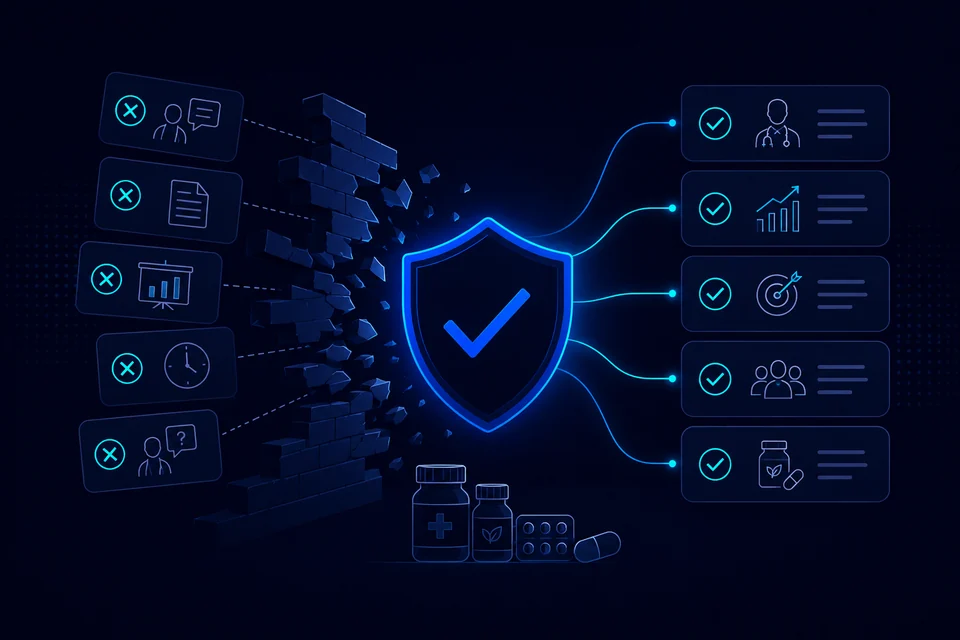
- Geolocation and PDFs are helpful, but they are not a detailing engine.
- HCPs don’t dislike being informed; they dislike inefficient visits.
- When you move past these myths and focus on workflows plus intelligence, you can control tomorrow’s commercial performance by improving how you detail today.
Pharma detailing still works when it is concise, relevant, measurable, and easy for medical reps to use in daily field work. The real myth is that detailing is either dead, too expensive, or impossible to modernize without a heavy CRM replacement.
Sometimes the choices around detailing and promotion can be overwhelming. Is digital detailing worth it? Do geolocation and PDFs give you enough control? How much does it really move the needle on commercial performance?
If you want better results from your field force, your business needs the right detailing workflow, not just another tool. And there are plenty of opinions: “just track visits,” “only global platforms are serious,” “HCPs hate detailing,” “our CRM is fixed, so we can’t touch it.”
At REVO, we’ve worked with multinationals, large regional enterprises, and pharma SMEs, helping them modernize detailing without losing field reality. This guide busts seven common myths so pharmaceuticals and nutraceuticals can design detailing that actually works.
Myth 1 – “Good detailing must be expensive and heavy”
Global CLM and big-brand platforms look impressive, and they can be right for some global organizations. But for many pharma and nutraceutical companies, they leave a big dent in the budget, take months to set up, and still don’t match how reps and managers work every day.
The myth says that “serious” e‑detailing must come with premium licenses, heavy agency work, long turnaround times, and extra fees for every content change.
A pharma‑native detailing engine can instead:
- go live in weeks, not months,
- digitize and update content without specialist coding,
- embed media into simple workflows rather than bespoke templates,
- treat updates as routine operations, not projects.
You don’t need the heaviest platform to get A‑class detailing. You need something designed around workflow and intelligence at your scale and markets.
Myth 2 – “GPS and PDFs give us all the control we need”
Some tools promise that GPS or geofencing alone will give you the control you need. Others say that tracking PDF opens is enough to understand detailing usage. Both rely on a single, shallow signal.
GPS tells you where someone is, not how they used their time, which brands they presented, or whether they followed your workflow. PDF opens confirm that a file was opened, not which parts were used, in what sequence, or with what impact.
Real control comes from workflow‑level visibility:
- which materials and slides are actually used,
- how much time is spent on key messages,
- how top performers structure their visits,
- where suspicious patterns or shortcuts appear—even when GPS looks fine.
When detailing runs on structured workflows, agentic AI can translate this behavior into clear coaching and training signals: what each rep does well, where they struggle, and what to focus on next—without needing a big analytics program every time.
Geolocation and PDFs are helpful, but they are not a detailing engine. Modern teams combine them with workflows, rich interaction data, and AI‑driven coaching to truly improve field promotion.
Myth 3 – “Modern detailing will take forever to implement”
If you try to roll out a clunky setup designed around a multinational CRM stack, implementation can take months and drain your team’s energy. Most pharma and nutraceutical businesses have heard those horror stories.
But modern detailing doesn’t have to be slow.
A pharma‑native detailing workflow should:
- be ready to use in weeks, not months,
- treat e‑detailing as a core part of the workflow, not a bolt‑on,
- integrate cleanly with your existing CRM and approval processes.
When evaluating solutions, ask nearby customers how long implementation really took, how quickly detail aids went live, and how adoption looks among reps and managers.
If “modern” means a year of disruption before value, you’re looking at the wrong solution.
Myth 4 – “Our infrastructure and CRM are fixed; we can’t improve detailing”
Many pharma and nutraceutical companies have spent years and serious budget on their CRM and internal tools. It’s easy for IT and SFE leaders to think, “Our CRM doesn’t support detailing well, but we can’t touch it now.”
Short‑term patches—custom fields, extra forms, improvised slides—only go so far. Over time, you miss out on:
- reliable visibility into how detailing happens,
- strong coaching and performance signals,
- consistent compliance and governance around promotion.
The key shift is this: detailing doesn’t have to live inside your CRM.
You can:
- keep CRM as the system of record,
- run a pharma‑native detailing engine on top,
- sync only the data that matters (accounts, visits, content usage, key signals).
This protects your CRM investment while letting you upgrade detailing quickly. REVO has done this with multinationals, large regional enterprises, and pharma SMEs who wanted better detailing without ripping out their CRM.
Myth 5 – “Physicians are time‑strapped and hate detailing”
Physicians are busy and protective of their time. That doesn’t mean they hate detailing; it means they hate wasted time. Long, unfocused visits with generic messages are the real problem.
Across REVO implementations we see that when detailing is structured correctly:
- the average detailing segment is around 2.5 minutes per visit,
- detailing typically accounts for more than 60% of a rep’s visit time.
Short, focused, visual detailing still happens—and it is central to the visit.
Good workflows help reps:
- get to the point quickly,
- tailor the story to the HCP’s context,
- use visuals that make complex information easier to absorb in a busy clinic.
“The medical representative is no longer the doctor’s main source of information. Today, reps need innovation, high emotional intelligence, and crisp, impactful communication.”
 Ahmed Abo Al FadlREVO Pharma PodcastS1E1 · Leadership in pharma
HCPs don’t dislike being informed; they dislike inefficient visits. Well‑designed detailing respects their time while still supporting appropriate product use.
Myth 6 – “My team can’t handle a new detailing workflow”
A common worry is that reps and first‑line managers “won’t be able” to use a new system. In practice, the real blockers are complexity and poor design, not capability.
You’re not asking people to become engineers. You’re giving them:
- a clean, pharma‑native app,
- workflows that match real visits,
- better tools to hit KPIs more easily and fairly.
When the workflow is intuitive and embedded in their day:
- adoption rises because it actually helps in visits,
- shortcuts and cheating are harder,
- coaching becomes more objective and specific.
Look for a solution that is seamless to use, designed around pharma jobs, and backed by ongoing customer success. Your team doesn’t need more complexity—they need tools that support the work they already know how to do.
Myth 7 – “Ethical marketing is over; in today’s generics red ocean, sales is king”
In many markets, especially where generics dominate, it can feel like ethics and quality no longer matter—only aggressive sales tactics do. The myth says that “ethical marketing time is over” and that in a red ocean, the only way to win is to push harder and worry less about how promotion is done.
The reality is the opposite: when price pressure is high and products look similar, how you promote becomes one of the few sustainable differentiators. Ethical, well‑structured detailing:
- builds trust with physicians and institutions,
- reduces compliance and reputational risk,
- supports long‑term brand preference instead of short spikes.
Modern detailing workflows help you codify ethical marketing into daily practice:
- clear content approval and governance,
- consistent messages across reps and territories,
- visibility into what is actually said and shown in the field.
“Sales is king” in the sense that revenue matters—but in pharmaceuticals & nutraceuticals, sales built on weak ethics and poor governance rarely lasts. The teams that win in a generics red ocean are often the ones who combine competitive execution with disciplined, transparent, and ethical promotion.
Modern detailing is not about buying the biggest platform
Modern detailing is not about buying the biggest platform or living with shallow signals like GPS and PDF opens. It’s about:
- better workflows for reps and managers,
- better experiences for physicians,
- and better visibility for commercial, SFE, and compliance.
When you move past these myths and focus on workflows plus intelligence, you can control tomorrow’s commercial performance by improving how you detail today.